1

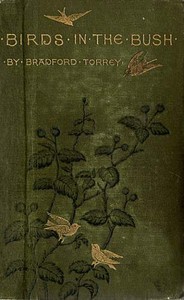
Birds in the Bush — Context and Discussion
(0 User reviews)
198
Project Gutenberg
2009
Not confirmed
Birds
Readers of public-domain and historical texts
Project Gutenberg digital edition
en
Edition facts
Words
68,789
Reading time
300 min
Text sections
8
The catalog record for Birds in the Bush — Context and Discussion provides practical reading context through 68,789 words, 5 hr estimated reading time, and 8 detected text sections.
The text analysis averages about 26.0 words per sentence, while the detected sections provide another way to judge how the source is divided.
Project Gutenberg metadata also associates the work with “Birds,” connecting these edition facts with the source record’s subject description.
Source:
Project Gutenberg record #28019
Bradford Torrey's 1885 essays blend precise ornithological observation with literary reflection, examining bird songs, behavior, and habitats from Boston Common to the White Mountains, with a naturalist's attention to detail and a writer's ear for language.
Read the complete public-domain text at its original source.
Read on Project GutenbergBradford Torrey opens his 1885 collection with a confession: Boston Common and the Public Garden are not an ideal field for bird study. They are, he admits, 'rather straitened and public.' Yet this constraint becomes a virtue. Spotting a cat-bird at the base of the Everett statue, he finds the familiar bird transformed by its urban setting—'like a bird of another feather.' This tension between limitation and compensation runs through the book. Torrey writes as a careful listener, noting that a bird's song may be 'extremely odd' or 'almost ridiculously faint,' and he is unafraid to admit when he has heard a species only once. His observations are grounded in specific moments: a Blackburnian warbler on Mount Clinton, a black-poll in the spruce forests of the White Mountains.
Songs and Scales
Torrey devotes considerable attention to the mechanics and aesthetics of bird song. He classifies American wood-warblers as 'minor songsters' in contrast to Old World warblers like the nightingale, but insists they are 'by no means to be despised.' His descriptions are precise: the summer yellow-bird sings late in the day; the blue yellow-back's song is a 'brief, hoarse, upward run—a kind of scale exercise'; the black-poll's 'zee, zee, zee' is so faint it might be mistaken for a kinglet's call. He notes that several warblers have 'remarkably rough voices and black throats,' and wonders whether the black-throated blue, black-throated green, and blue golden-wing might be more closely related than systematists have determined. Torrey also observes that some warblers learn multiple songs: on Mount Clinton he heard two Blackburnians singing 'two entirely distinct songs,' one ending with 'zip, zip, zip,' the other resembling a fragment of the winter wren's melody. He even ventures a musical analogy, calling the prairie warbler's effort an 'étude'—longer and in a higher key than the blue yellow-back's.
Character in Feathers
The essay 'Character in Feathers' suggests Torrey's interest in bird behavior as revealing personality. He describes a cat-bird on Boston Common steadying itself 'with oscillations of his tail,—a conveniently long balance-pole' before disappearing into a geranium bed. This attention to posture and movement recurs throughout. Torrey is also attuned to the limitations of his own knowledge: he admits he has heard a particular warbler's song only once, and speculates that the bird 'may have another and better song, which he reserves for times of more leisure.' He does not claim to have exhausted a species' repertoire. His method is cumulative and comparative. He notes that the bay-breasted warbler's song is similar to the black-poll's but 'hardly so weak and formless,' and uses this to suggest a recent common ancestry—a hypothesis grounded in song structure as well as plumage.
Urban and Wild Spaces
Torrey's settings range from the constrained 'narrow limits' of a city park to the high spruce forests of the White Mountains. He finds compensation in the unexpected: a cat-bird in the Garden becomes remarkable precisely because of its setting. In the mountains, he listens to Blackburnians on Mount Clinton and notes the difficulty of spotting a black-poll warbler whose song is 'almost ridiculously faint.' The contrast between public and private observation is explicit: a modest ornithologist would prefer a place where he could 'stand still and look up without becoming himself a gazing-stock.' Yet Torrey accepts his circumstances, finding that 'our disappointments will be on the right side of the account.' His writing balances the specific—a bird's tail oscillations, a song's upward run—with broader reflections on how place shapes perception. The White Mountains section, in particular, shows him attending to altitude and forest type as factors in bird distribution.
Torrey's essays reward a patient reader. He builds his observations from single encounters and repeated listenings, never pretending to have the final word. His prose is direct, his comparisons apt, and his willingness to say 'I do not call to mind' or 'I am sorry that I have myself heard it only on one occasion' lends credibility to his more confident claims. Readers interested in the intersection of natural history and personal essay will find here a model of attentive, unpretentious writing. The book is best read not as a field guide but as a companion for quiet walks—one that sharpens the ear without drowning out the birds themselves.
I keep thinking about Torrey’s way of listening—how a bird’s song could feel like a quiet conversation with the place it lived. That same patience lives in Color Key to North American Birds with bibliographical appendix — Reading Notes, like a gentle field journal you might return to on a slow evening, just to sit with what was noticed once, carefully.
There are no reviews for this eBook.
There are no comments for this eBook.
Reader reflection
What did you think of this book?
Answer a few questions and save a private reflection on this device.
Your progress
0
/
10
2
Did this book hold your interest?
3
Is this a title you would suggest to others?
4
What was the reading difficulty like?
5
How distinctive were its ideas or approach?
6
How clear did the writing feel?
7
Did it raise ideas you would like to talk about?
8
Did you relate to its people, ideas, or situations?
9
In one sentence, what did you learn?
10