1

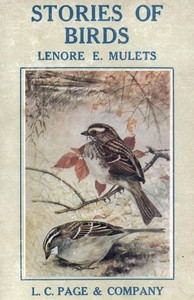
Stories of Birds — Themes and Context
(0 User reviews)
448
Project Gutenberg
2007
Not confirmed
Birds -- Juvenile literature
Readers of public-domain and historical texts
Project Gutenberg digital edition
en
Edition facts
Words
27,659
Reading time
121 min
Text sections
5
The catalog record for Stories of Birds — Themes and Context provides practical reading context through 27,659 words, 2 hr 1 min estimated reading time, and 5 detected text sections.
The text analysis averages about 13.3 words per sentence, while the detected sections provide another way to judge how the source is divided.
Project Gutenberg metadata also associates the work with “Birds -- Juvenile literature,” connecting these edition facts with the source record’s subject description.
Source:
Project Gutenberg record #20547
This editorial note examines how Lenore Elizabeth Mulets blends factual bird descriptions with mythological stories and verse, using shifts in narrative pace—from brisk field notes to lyrical legends—to create a varied reading experience for children.
Read the complete public-domain text at its original source.
Read on Project GutenbergLenore Elizabeth Mulets’ Stories of Birds alternates between two distinct modes: concise, observation-based field lessons and expansive mythological tales. The book’s preface frames it as both a verification of facts and a source of “stories, poems, and songs to make facts beautiful,” a duality that shapes its structure. Each chapter opens with a narrative—often a fable or legend—then closes with a factual “All About” section. This pattern creates a rhythm of immersion and analysis, inviting young readers to move from wonder to understanding.
From Field Notes to Myth
The book’s most striking feature is its abrupt shift in register between sections. The “All About” entries read like field guides: terse, specific, and impersonal. For instance, the kingfisher entry notes its “song—harsh, discordant, laughing chuckle or rattle—never musical” and describes its plumage with clinical precision: “upper parts blue—wings and tail with white markings—lower parts white with two blue bands across breast.” In contrast, the preceding myth of Halcyone and the kingfisher is lush and dramatic, with sentences that stretch across multiple clauses: “The waves rose high and broke in white crests of foam. The rain poured down. The wind crept up and sprang upon the little boat with fury.” This juxtaposition of dry taxonomy and poetic narrative is the book’s central technique.
Pacing the Legend of Halcyone
The Halcyone myth exemplifies how Mulets manipulates pace. The story begins with a calm sea and gentle winds, then accelerates into a storm: “The moaning of the wind was heard. Dark clouds scurried across the sky.” Short, staccato sentences mimic the storm’s violence. After the king’s death, the narrative slows: “Weeks passed. Months passed. A year went by.” This temporal ellipsis creates a sense of prolonged grief. The climax—Halcyone’s transformation—is rendered in measured, almost ritualistic prose: “And as she prayed, lo, she rose slowly into the air. The folds of her blue robe enwrapped her.” The final explanation of “halcyon days” returns to a calm, explanatory tone, closing the loop between myth and natural phenomenon.
Voice and Direct Address
Mulets frequently addresses the reader directly, especially in the narrative sections. The preface asks rhetorical questions: “Where can you find a lad who does not treasure among his secrets the nesting-place of some pair of birds?” This establishes a conversational, almost conspiratorial tone. In the stories, the narrator often steps in to guide interpretation, as when Juno declares, “It is better that she should know what has befallen him whom she loved than to wander thus in uncertainty.” The voice is authoritative yet warm, positioning the adult author as a knowledgeable companion. The factual sections, by contrast, adopt a neutral, instructional voice, using bullet-like lists and imperative verbs: “Comes north in early March—remains until December.”
Readers may find it useful to read the narrative and factual sections of each chapter in sequence, noting how the same bird is treated in two different keys. The book rewards attention to its shifts in sentence length and diction, which signal transitions between storytelling and science. Mulets’ deliberate pacing—from the brisk rhythms of field notes to the measured cadences of legend—gives Stories of Birds a distinctive, layered texture.
That rainy afternoon, Mulets’s blend of feather-and-fable made me linger on the bittersweet edges of migration, on how far a bird’s wings carry it from its myth. Later, I found myself flipping through Conservation of marine birds of northern North America: papers from the international symposium held at the Seattle Hyatt House — A Reader’s Guide, and the legends quietly receded, leaving only the stark, patient fact of oceans and their fragile tenants.
There are no reviews for this eBook.
There are no comments for this eBook.
Reader reflection
Take a moment to reflect on this book
Create a short personal record of your experience with this book.
Your progress
0
/
10
2
Did this book hold your interest?
3
Would you pass this book on to a friend?
4
What was the reading difficulty like?
5
Did you gain anything practical from the text?
6
How closely did the book connect with your experience?
7
Which aspect of the book did you value most?
8
How original did the book feel?
9
What did this book teach you most?
10