1

The Woodpeckers — Inside the Classic
(0 User reviews)
29
Project Gutenberg
2011
Not confirmed
Birds; Woodpeckers
Readers of public-domain and historical texts
Project Gutenberg digital edition
en
Edition facts
Words
30,899
Reading time
135 min
Text sections
5
For The Woodpeckers — Inside the Classic, the stored edition analysis reports 30,899 words, 2 hr 15 min estimated reading time, and 5 detected text sections.
The text analysis averages about 20.7 words per sentence, while the detected sections provide another way to judge how the source is divided.
Project Gutenberg metadata also associates the work with “Birds,” connecting these edition facts with the source record’s subject description.
Source:
Project Gutenberg record #35062
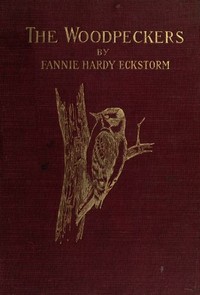
Examines woodpecker anatomy and behavior through precise observation of bills, feet, tails, and tongues, arguing that each species' tools are adapted to its feeding habits. Eckstorm's 1901 study blends natural history with cautious reasoning about form and function.
Read the complete public-domain text at its original source.
Read on Project GutenbergFannie Hardy Eckstorm opens The Woodpeckers with a fable: the Sphinx of Greek myth posed riddles to travelers, and today, she writes, “the world is full of unguessed riddles” posed by birds and flowers. This framing sets the tone for a book that treats woodpeckers not as passive specimens but as active puzzles demanding careful observation. Eckstorm’s prose is direct and concrete, often comparing bird anatomy to human tools—a woodpecker’s foot, she notes, resembles “an iceman’s nippers with their short handles and long, sharp-toothed jaws.” Such analogies make her technical descriptions vivid without sacrificing precision.
A Drill and a Pick-Axe
Eckstorm devotes an entire chapter to the woodpecker’s bill, which she calls “a combination of drill and pick-axe.” She draws attention to the shape of the bill across species: those that drill most, like the hairy and downy woodpeckers, have nostrils covered by “little tufts of stiff feathers” that keep out dust. In contrast, the red-head and sapsucker show only “a few loose bristles,” and the flicker’s tufts barely cover the nostril. Eckstorm is careful not to overstate the evidence. She notes that crows and finches also have covered nostrils, though they do not dig in bark, and warns readers not to “mistake cause and accompaniment.” This cautious reasoning—distinguishing adaptation from coincidence—is a hallmark of her method. She concludes that the bill’s shape varies with the food the bird eats and the way it procures that food, but she stops short of claiming that diet alone determines structure.
The Foot as a Climbing Tool
In the chapter on the woodpecker’s foot, Eckstorm invites readers to compare it to a chicken’s or a sparrow’s. She points out that the tarsus is short and the toes long—a design that helps the bird grip vertical surfaces. “I never see a woodpecker’s foot without thinking of an iceman’s nippers,” she writes, emphasizing the need for equal spread front and back. Perching birds, she explains, have a short hind toe because they sit balanced on a limb; woodpeckers, climbing out of balance, require a nearly symmetrical grip. This functional explanation is typical of Eckstorm’s approach: she grounds each anatomical detail in the bird’s daily activity. She also notes that the toes are equipped with strong claws, and that the arrangement of the toes—two forward, two backward in most species—provides a stable platform for hammering and clinging.
The Tail as a Prop
Eckstorm treats the woodpecker’s tail as a third tool, essential for bracing the body against the tree. She describes the stiff, pointed tail feathers that act as a prop, and she provides diagrams to show how the curvature of the feathers varies among species. The middle tail feathers, she observes, are especially strong in woodpeckers that spend the most time climbing, such as the hairy and downy. In contrast, flickers, which feed more on the ground, have more flexible tails. Eckstorm uses these differences to link structure to habit: a bird that drills into wood needs a rigid support, while one that forages in open fields does not. She also compares the woodpecker’s tail to that of the brown creeper and chimney swift, noting that each bird’s tail is shaped by its particular mode of life. This comparative method reinforces her central argument that form follows function.
The Tongue as a Spear
The woodpecker’s tongue, Eckstorm writes, is “a more specialized tool, limited to fewer uses, but more effective within its limits.” She describes its length, its barbed tip, and the intricate bones that allow it to extend far beyond the bill. The tongue-bones, or hyoids, are shown in diagrams for the flicker, sapsucker, and golden-fronted woodpecker, illustrating how they wrap around the skull. Eckstorm explains that the tongue is used to extract grubs from deep tunnels in wood—a task that requires both reach and adhesion. She notes that the tongue’s structure varies with diet: insect-eating woodpeckers have longer, more barbed tongues than those that eat fruit or sap. As with the bill and foot, she refrains from claiming that diet determines tongue shape, but she presents the correlation as strong evidence of adaptation. The chapter ends with a summary of how each tool—bill, foot, tail, tongue—works together to fit the woodpecker for its particular kind of life.
Eckstorm’s The Woodpeckers is best read as a series of linked investigations rather than a comprehensive field guide. She builds each chapter around a question—how does the bird catch a grub? how does it court?—and answers it through close attention to structure and behavior. Readers interested in the logic of natural history will find her method instructive, especially her willingness to acknowledge uncertainty. The book rewards those who read with a specimen in mind: a downy at the feeder, a flicker on the lawn. Eckstorm’s voice is that of a patient teacher, not a showman, and her observations repay careful study.
There’s something almost meditative about watching a woodpecker’s steady, deliberate work—that quiet sense of purpose. It reminds me of how Fannie Hardy Eckstorm’s careful arguments linger long after you’ve closed the book. I once felt that same patient wonder flipping through The zoology of the voyage of H.M.S. Beagle [vol. 3 of 5] — Edition Insights, where each small observation seems to hold its breath, waiting to be understood.
There are no reviews for this eBook.
There are no comments for this eBook.
Reader reflection
Take a moment to reflect on this book
Create a short personal record of your experience with this book.
Your progress
0
/
10
2
Did this book hold your interest?
3
Is this a title you would suggest to others?
4
How demanding did the text feel?
5
Which part made the strongest impression?
6
Do you expect to return to this book?
7
Did the book offer a fresh perspective?
8
Would you like to discuss this book with someone?
9
In one sentence, what did you learn?
10