1

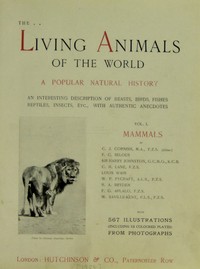
The Living Animals of the World, Volume 1 (of 2) A Popular Natural History — Themes and Context
(0 User reviews)
843
Project Gutenberg
2019
Not confirmed
Animals; Zoology
Readers of public-domain and historical texts
Project Gutenberg digital edition
en
Edition facts
Words
172,832
Reading time
752 min
Text sections
29
This digital edition of The Living Animals of the World, Volume 1 (of 2) A Popular Natural History — Themes and Context is described by source-level measurements including 172,832 words, 12 hr 32 min estimated reading time, and 29 detected text sections.
The text analysis averages about 20.3 words per sentence, while the detected sections provide another way to judge how the source is divided.
Project Gutenberg metadata also associates the work with “Animals,” connecting these edition facts with the source record’s subject description.
Source:
Project Gutenberg record #60000
This editorial note examines the authorial choices in diction, dialogue, and description within a popular natural history volume, focusing on how contributors blend scientific observation with anecdotal narrative to depict mammals.
Read the complete public-domain text at its original source.
Read on Project GutenbergThe opening chapter on apes and monkeys immediately establishes a descriptive strategy that oscillates between clinical taxonomy and vivid behavioral portraiture. The text notes that a young chimpanzee can express "anger, pleasure, fear" through facial expressions, a phrasing that anthropomorphizes while retaining observational precision. This dual register—scientific naming alongside emotive characterization—recurs throughout the volume, as when the quagga's call is rendered as "quā-hā-hā, quā-hā-hā," an onomatopoeic transcription that bridges field notes and literary evocation.
Diction and the Vernacular of Natural History
The contributors frequently employ specialized terminology—such as "telegony" in discussing zebra hybrids—but counterbalance it with colloquial asides. The quagga entry, for instance, shifts from technical description of "rufous brown" coloration to a conversational remark: "This is, we believe, the only known photograph from life of this very rare animal." Such interjections create a tone of shared discovery, as if the reader is being confided in. The text also incorporates indigenous nomenclature, explaining that "quagga" is of Hottentot origin, an imitation of the animal's neigh. This choice grounds the work in local knowledge while maintaining an authoritative editorial voice.
Visual Description as Scientific Argument
Descriptive passages often serve evidentiary purposes. The account of the quagga's stripes—"strongly banded on the head and neck, the dark brown stripes becoming fainter on the shoulders and dying away in spots and blotches"—does more than depict; it visually argues for the quagga's relation to Burchell's zebra. Similarly, the wild ass entry uses markings to distinguish subspecies: the Somaliland form is "of a paler colour, has the dorsal stripe but faintly marked, and is without a cross stripe over the shoulders." These details are not merely ornamental but function as taxonomic evidence, reflecting the period's reliance on external morphology for classification.
Anecdotal Evidence and the Voice of the Field Naturalist
Firsthand observations lend immediacy to the prose. The wild ass is described as "so fleet and enduring that, excepting in the case of foals and mares heavy in young, it cannot be overtaken even by a well-mounted horseman." This sentence combines practical field experience with a subtle acknowledgment of the observer's limitations. The text also includes references to Professor Ewart's experiments on telegony, citing specific breeding outcomes to refute a then-popular theory. Such inclusions reveal a editorial willingness to engage with contemporary scientific debates, grounding the popular account in ongoing research.
The Role of Photography in Shaping Description
Photographs are explicitly referenced as sources of authority. The quagga entry notes that the accompanying image is "the only known photograph from life," lending the description a documentary weight. Captions often extend the text's descriptive function, as in "Zebras on Table Mountain. Notice Cape Town in the far distance." This integration of visual and verbal description suggests that the editors saw photography not merely as illustration but as a form of evidence that could confirm or challenge written accounts. The interplay between image and text shapes the reader's understanding of animal appearance and behavior.
Readers attentive to authorial choices will find that this volume's diction—alternately technical and intimate—reflects a deliberate effort to make natural history accessible without sacrificing rigor. The contributors' reliance on visual detail, anecdote, and photographic evidence reveals a editorial philosophy that values concrete observation over abstract generalization. Approaching the text with an eye to these rhetorical strategies enriches the experience of a work that is as much about the art of description as about the animals themselves.
I have returned many times to that stout natural history, relishing how its writers pause over the individual beast—the breath, the glance—even as they catalogue order and genus. The same unhurried intimacy marks Wild Animals of the Rockies With a List of Mammals found in Rocky Mountain National Park — Reading Companion, where every hoofprint feels counted like a quiet friend's. They share a patient, wondering gaze. No rush, just company.
There are no reviews for this eBook.
There are no comments for this eBook.
Reader reflection
Before you leave, reflect on the book
Use these questions to collect your thoughts before moving on.
Your progress
0
/
10
2
Did this book hold your interest?
3
Is this a title you would suggest to others?
4
How demanding did the text feel?
5
Would this book work well in a reading group?
6
What was the strongest part of the book?
7
How clearly were the main ideas presented?
8
How would you describe its reading pace?
9
What changed or sharpened your thinking?
10