1

Squirrels and Other Fur-Bearers — Background and Themes
(0 User reviews)
2407
Project Gutenberg
2008
Not confirmed
Animal behavior; Mammals
Readers of public-domain and historical texts
Project Gutenberg digital edition
en
Edition facts
Words
37,422
Reading time
163 min
Text sections
6
Squirrels and Other Fur-Bearers — Background and Themes can be approached with a clearer sense of reading commitment from its source measurements: 37,422 words, 2 hr 43 min estimated reading time, and 6 detected text sections.
The text analysis averages about 22.0 words per sentence, while the detected sections provide another way to judge how the source is divided.
Project Gutenberg metadata also associates the work with “Animal behavior,” connecting these edition facts with the source record’s subject description.
Source:
Project Gutenberg record #24388
John Burroughs observes squirrels, weasels, and other mammals in the wild, blending precise natural history with vivid, often dramatic anecdotes that reveal animal behavior and his own reactions.
Read the complete public-domain text at its original source.
Read on Project GutenbergJohn Burroughs opens "Squirrels and Other Fur-Bearers" with a detective-like puzzle: finding chestnut burrs cut cleanly from a tree and scattered on the ground. He reconstructs the squirrel's reasoning—that cutting the burrs early prevents theft by crows, jays, and other animals—and marvels at the animal's foresight. This moment sets the tone for the book: Burroughs treats wild creatures as intentional actors, not mere instinct-driven automatons. His prose is observational yet speculative, blending natural history with a storyteller's flair. The excerpts show a writer who is both a careful field naturalist and a participant in the scenes he describes, as when he captures a weasel with his bare hands. Readers should expect a mix of patient description and sudden, gripping action.
Reasoning Animals
Burroughs attributes deliberate thought to the squirrel that cut the chestnut burrs, imagining its internal monologue about timing and competitors. This anthropomorphic inference is grounded in close observation: he notes that every burr was cut with an inch of stem, ruling out accident. The passage demonstrates his method—he uses physical evidence to infer motive, then tests his hypothesis by collecting the burrs himself. Later, describing a weasel chase, he shifts to a more visceral mode: the weasel is "devilish and uncanny," its persistence "like fate." Yet even here, he records specific behaviors—the weasel's grip on a chicken, its dodging of blows—that anchor the drama in fact. The book thus moves between sympathetic interpretation and stark realism, never losing sight of the animal's otherness.
The Observer as Participant
Burroughs does not remain a passive watcher. In the weasel episode, he intervenes directly: he "planted my foot upon the weasel," then grips it behind the ears and lifts it to study its face. His language conveys both scientific curiosity and personal emotion—"savage glee"—as he examines the creature's "gleaming eyes" and "array of threatening teeth." This involvement extends to his dog, Nip, who joins the fray and is bitten on the lip. Burroughs notes that in a "fair encounter" the weasel would draw first blood, revealing his practical knowledge of animal combat. These scenes remind readers that the naturalist's role is not always detached; the book captures moments when observation becomes confrontation, and the observer's own reactions become part of the record.
Terror in the Underbrush
A recurring theme in the excerpts is the fear that smaller animals feel toward predators. Burroughs describes a rat pursued by a weasel that "rush[es] into a room, uttering dismal cries, and seek[s] the protection of a man in bed." A chipmunk climbs a tall tree, then "let[s] go its hold and drop[s] with a cry of despair." These anecdotes are not merely sensational; they illustrate the weasel's reputation as a relentless hunter. Burroughs collects such stories from friends, broadening his own observations. The effect is to build a portrait of a creature that inspires "terror" across species, including humans—one friend backs away from a weasel that "began leaping up before him, within a few feet of his face." The book thus documents not only what animals do, but the emotional responses they provoke.
Structure and Scope
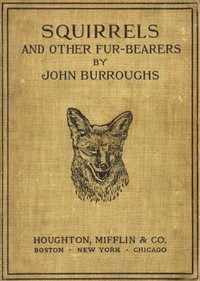
The table of contents reveals a systematic survey: fifteen chapters cover squirrels, chipmunks, woodchucks, rabbits, muskrats, skunks, foxes, weasels, minks, raccoons, porcupines, opossums, wild mice, and two general chapters on "Glimpses of Wild Life" and "A Life of Fear." Each chapter likely follows a similar pattern—introducing the animal through a striking encounter, then weaving in natural history. The excerpts suggest that Burroughs favors narrative over dry description; even the index lists illustrations, including a frontispiece photograph of a red fox. Readers should expect a collection of essays rather than a field guide, with each chapter standing somewhat alone. The closing chapter title, "A Life of Fear," hints at a unifying theme: the constant vigilance required of prey animals in the wild.
Burroughs writes from the late nineteenth century, a time when natural history writing often blended science with personal anecdote. Readers today may find his anthropomorphism dated, but his sharp eye for detail and willingness to engage directly with animals—even dangerous ones—gives the book a lasting vitality. Approach each chapter as a self-contained essay, and pay attention to the small behaviors he records: the way a squirrel cuts a burr, the angle of a weasel's leap. These observations, more than any grand theory, are the book's enduring contribution.
Burroughs made me feel like I was sitting quiet in the leaves, watching a weasel’s fierce little life unfold. There’s a lingering ache in that kind of attention. I found the same slow hush in Mammals of the Grand Mesa, Colorado — Reading Notes, a place where every creature seems to hold its breath just for you. It stayed with me, that stillness.
There are no reviews for this eBook.
There are no comments for this eBook.
Reader reflection
What was your reading experience?
Capture what you thought, learned, and would like to remember.
Your progress
0
/
10
2
What was your overall reaction to the book?
3
Is this a title you would suggest to others?
4
How much effort did this book require?
5
How would you rate its originality?
6
Do you expect to return to this book?
7
Did this book create an emotional response?
8
Did the book give you something worth debating?
9
Which lesson or insight stayed with you?
10