1

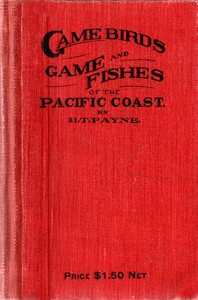
Game Birds and Game Fishes of the Pacific Coast — Background and Themes
(0 User reviews)
53
Project Gutenberg
2011
Not confirmed
Game and game-birds -- Pacific Coast
Readers of public-domain and historical texts
Project Gutenberg digital edition
en
Edition facts
Words
44,975
Reading time
196 min
Text sections
11
For Game Birds and Game Fishes of the Pacific Coast — Background and Themes, the stored edition analysis reports 44,975 words, 3 hr 16 min estimated reading time, and 11 detected text sections.
The text analysis averages about 25.0 words per sentence, while the detected sections provide another way to judge how the source is divided.
Project Gutenberg metadata also associates the work with “Game and game-birds -- Pacific Coast,” connecting these edition facts with the source record’s subject description.
Source:
Project Gutenberg record #38032
H. T. Payne's 1913 guide to Pacific Coast game birds and fishes, written from a practical sportsman's perspective with personal anecdotes and non-technical descriptions, illustrated with photographs of live and mounted specimens.
Read the complete public-domain text at its original source.
Read on Project GutenbergH. T. Payne opens his 1913 guide by framing it as a practical resource for the growing number of licensed sportsmen and anglers on the Pacific Coast, noting that nearly twenty percent of those over fifteen hold hunting licenses. He explicitly distinguishes his work from ornithological or ichthyological studies, writing from the standpoint of a hunter with over half a century of experience. The introduction emphasizes plain language over technical terms, though he includes tabulated scientific classifications for those who want them. A notable feature is the use of photographs of actual birds and fishes, which he claims capture true feather markings and color gradations better than drawings.
Personal Experience as Evidence
Payne frequently grounds his descriptions in personal hunting stories, as seen in his account of cooking two swans in early Los Angeles. He recalls a disastrous first attempt at roasting a trumpeter swan, which turned out so tough that even his hounds refused it after the first bird, and ate the second only out of hunger. The anecdote reveals his willingness to admit mistakes—he had assumed swans would be fine eating, but learned that only a half-grown swan is palatable. Such stories serve as memorable evidence for the practical traits of each species, rather than relying solely on external data.
Non-Technical Descriptions for Identification
Payne avoids scientific jargon in his species accounts, using plain language to describe distinguishing features. For example, he notes that the whistling swan differs from the trumpeter mainly by a small yellow spot at the V-shaped point of the bill where it meets the eye. This accessible approach is consistent throughout the excerpts, making the book usable for novice hunters. He also includes ready-reference diagrams that list scientific and common names, relationships, breeding grounds, and general range for each family, providing a bridge for readers who want more formal taxonomy without overwhelming the main text.
Regional Focus on Pacific Coast Variety
The book concentrates on species found along the Pacific Coast, from California to Oregon and Washington. Payne notes that the region is especially rich in waders and shore birds, with upwards of forty species common and ten more occasional visitors. He observes that many shore birds are hunted less locally than in the East, because the abundance of larger game makes them less attractive to Pacific sportsmen. This regional specificity gives the work a focused scope, contrasting with broader national guides. The author’s half-century of experience on these grounds lends authority to his observations about local habits and availability.
Photographic Illustrations as a Key Feature
Payne emphasizes that his illustrations are photographs of live or carefully mounted birds and fishes, not drawings. He argues this is a new and important feature for students, as photographs show the perfect markings of every feather and true gradation of color as appearing in nature. The excerpts do not include the images themselves, but the text repeatedly references them as integral to identification. This reliance on photography reflects early 20th-century advances in reproduction and Payne’s commitment to practical, visual learning for the sportsman.
Readers approaching this work should expect a blend of field guide and memoir, with personal anecdotes providing memorable hooks for identification. The book is best used as a companion for hunters and anglers who want to learn about local species without wading through technical terminology. Payne’s conversational tone and specific regional focus make it a distinctive record of Pacific Coast game at the turn of the century.
The rain kept me indoors with Payne’s old photographs of mounted quail, their glass eyes staring past the century. Later, I wondered what they actually ate—those berries and seeds—and that thought led me, almost by accident, to Food Habits of the Thrushes of the United States — A Closer Reading. The same quiet patience, but for the living birds, their small stomachs full of a quieter knowledge.
There are no reviews for this eBook.
There are no comments for this eBook.
Reader reflection
Take a moment to reflect on this book
Create a short personal record of your experience with this book.
Your progress
0
/
10
2
How did the book work for you overall?
3
Would you encourage someone else to read it?
4
How demanding did the text feel?
5
Which part made the strongest impression?
6
How distinctive were its ideas or approach?
7
Could you see yourself revisiting this book?
8
What was its emotional impact?
9
What did this book teach you most?
10