1

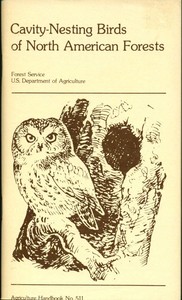
Cavity-Nesting Birds of North American Forests Agriculture Handbook 511 — Background and Themes
(0 User reviews)
3419
Project Gutenberg
2015
Not confirmed
Birds -- Nests; Birds -- North America; Forest birds -- North America; Cavity-nesting birds -- North America
Readers of public-domain and historical texts
Project Gutenberg digital edition
en
Edition facts
Words
25,148
Reading time
110 min
Text sections
5
Before opening Cavity-Nesting Birds of North American Forests Agriculture Handbook 511 — Background and Themes, the edition data offers a quick orientation: 25,148 words, 1 hr 50 min estimated reading time, and 5 detected text sections.
The text analysis averages about 14.3 words per sentence, while the detected sections provide another way to judge how the source is divided.
Project Gutenberg metadata also associates the work with “Birds -- Nests,” connecting these edition facts with the source record’s subject description.
Source:
Project Gutenberg record #49172
This handbook describes habitat, cavity requirements, and foods for 85 cavity-nesting bird species in North American forests, emphasizing the ecological importance of dead and decaying trees.
Read the complete public-domain text at its original source.
Read on Project GutenbergThe handbook opens with a clear warning: intensive removal of dead or decadent trees would disastrously affect breeding habitat for many birds that help control destructive forest insects. This sets the tone for a work that is as much a conservation argument as a species-by-species reference. The authors—two from the Forest Service and two from the Fish and Wildlife Service—combine field observations with published literature to produce a systematic account of 85 cavity-nesting birds.
A Species-by-Species Structure with Recurring Categories
Each species entry follows a rigid three-part format: Habitat, Nest, and Food. This uniformity allows quick comparison across species. For example, the black-capped chickadee entry notes its diet is 70 percent animal matter, with caterpillars, moths, spiders, and beetles listed. The Carolina chickadee entry then states its food habits are “very similar.” The Mexican chickadee entry, however, reports “No information on diet was found in the literature.” This honest admission of gaps is a recurring feature, appearing for several species. The structure itself becomes a tool: readers can see at a glance which species have well-studied diets and which remain poorly known.
Movement Between Forest Types and Elevations
The handbook moves systematically across North American forests, from eastern deciduous woodlands to western coniferous zones. The black-capped chickadee is described in eastern forests, while the mountain chickadee inhabits western coniferous forests from 6,000 to 11,000 feet. The gray-headed chickadee is limited to western Canada and Alaska, preferring broken forests or edges of aspen, willow, and spruce. This geographic progression mirrors the birds’ own movements across the continent. The entries often cite specific locations—Chiricahua Mountains, Inyo National Forest, Wet Mountains—grounding the descriptions in real places.
Recurring Images: Decaying Wood and Excavated Cavities
Throughout the handbook, certain images recur: dead trunks, decaying stubs, snags, and abandoned woodpecker holes. The black-capped chickadee “usually excavate[s] their own cavities, but will use natural cavities or nest boxes.” The mountain chickadee “usually nest[s] in natural cavities or abandoned woodpecker holes, and probably do not excavate their own cavities if suitable ones are available.” The gray-headed chickadee selects “old woodpecker holes or natural cavities.” These repeated details reinforce the central theme: cavity-nesting birds depend on a specific, often ephemeral resource—dead or decaying wood—that is threatened by intensive forest management.
Evidence from Stomach Contents and Field Observations
The handbook frequently cites specific studies to support its claims about diet. For the mountain chickadee, it reports that 639 needle miner caterpillars were found in stomachs of 10 birds collected in the Inyo National Forest. Another study from the Wet Mountains, Colorado, found 75 percent of the summer diet was insects, including large numbers of spruce aphids. These concrete numbers give the work a scientific grounding. The authors also include their own field observations: “In Arizona, we have found five nests in live aspen, three in aspen snags, two in ponderosa pine snags, and one in a white fir snag.” This blend of published data and firsthand accounts adds authority.
Readers should approach this handbook as a reference tool rather than a continuous narrative. The uniform species entries make it easy to locate specific information, but the work also rewards browsing: the recurring patterns of habitat use and diet reveal the interconnectedness of forest ecosystems. The preface and introductory material provide essential context for understanding the conservation message that runs through the species accounts.
Flipping through the agricultural handbook, I kept returning to the quiet logic of dead wood—how a hollow trunk becomes a home. It reminded me of a different, warmer landscape, where the same patient architecture plays out under a Mexican sun. That thought led me to the quiet joy of Birds from Coahuila, Mexico — Reading Companion, and suddenly the forest felt less like a manual and more like a shared, ongoing story.
There are no reviews for this eBook.
There are no comments for this eBook.
Reader reflection
Record your reading impressions
A brief reflection can help important ideas stay with you longer.
Your progress
0
/
10
2
How much did you enjoy the reading experience?
3
Would you pass this book on to a friend?
4
How demanding did the text feel?
5
Did any part of the book feel personally relevant?
6
Could you apply anything you learned?
7
How strongly did the book affect you emotionally?
8
Could you see yourself revisiting this book?
9
Which lesson or insight stayed with you?
10