1

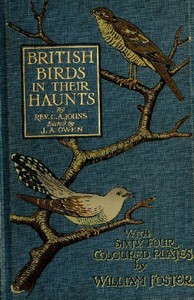
British Birds in Their Haunts — Text and Context
(0 User reviews)
282
Project Gutenberg
2011
Not confirmed
Birds -- Great Britain
Readers of public-domain and historical texts
Project Gutenberg digital edition
en
Edition facts
Words
164,637
Reading time
716 min
Text sections
26
British Birds in Their Haunts — Text and Context can be approached with a clearer sense of reading commitment from its source measurements: 164,637 words, 11 hr 56 min estimated reading time, and 26 detected text sections.
The text analysis averages about 27.5 words per sentence, while the detected sections provide another way to judge how the source is divided.
Project Gutenberg metadata also associates the work with “Birds -- Great Britain,” connecting these edition facts with the source record’s subject description.
Source:
Project Gutenberg record #38077
This editorial note examines how the catalog subject 'Birds -- Great Britain' aligns with the actual content of C. A. Johns's work, noting its blend of personal anecdotes, scientific description, and historical lore, while highlighting the editor's updates to taxonomy and nomenclature.
Read the complete public-domain text at its original source.
Read on Project GutenbergThe catalog subject 'Birds -- Great Britain' suggests a straightforward field guide, but the excerpts reveal a work that intertwines personal observation, classical allusion, and taxonomic revision. The editor, J. A. Owen, states she preserved 'Mr. Johns' delightful personal stories' while updating nomenclature 'in accordance with present-day knowledge.' This dual aim—retaining anecdotal charm while modernizing science—shapes the book's character.
The excerpts show entries that mix precise measurements (e.g., 'Length twenty-six inches') with folk beliefs, such as Pliny's tale of eagles testing their young by the sun. The text also includes regional notes, like the Rough-legged Buzzard's appearance on 'Yarmouth Denes,' grounding the work in specific British locales. The catalog subject thus understates the book's blend of natural history, folklore, and editorial intervention.
Anecdote and Authority in Species Accounts
The species accounts in the excerpts combine empirical detail with narrative. For the Golden Eagle, the text gives precise plumage descriptions ('lustrous reddish brown') and measurements ('breadth eight feet'), then pivots to a fable from Pliny about eagles forcing chicks to gaze at the sun. This juxtaposition is typical: the author treats classical lore as a point of interest, not fact, but does not dismiss it. The editor's preface notes that she kept 'all Mr. Johns' delightful personal stories,' suggesting that such anecdotes were valued as part of the work's appeal.
The Rough-legged Buzzard entry similarly mixes observation ('flies slowly and deliberately') with a caveat about its rarity in Britain. The text notes that 'there are no well-authenticated instances of its breeding in this country,' a statement that reflects the book's reliance on verifiable records. Yet the inclusion of the Pliny tale shows a willingness to include material that is more cultural than scientific. This blend of authority and anecdote may surprise readers expecting a dry reference work.
Editorial Updates and Taxonomic Shifts
The editor, J. A. Owen, explicitly states that she 'brought the scientific arrangement of the species up to date' and altered nomenclature. The table of contents shows a systematic arrangement beginning with Passeres, which she justifies because 'modern ornithologists are now nearly all agreed that this order attains the highest Avian development.' This editorial voice is present throughout, though the excerpts do not show how extensively she modified the original text.
The inclusion of a glossary of 'Common and Provincial Names and of Technical Terms' further indicates an effort to make the work accessible. The catalog subject 'Birds -- Great Britain' does not capture this editorial layer. Readers should be aware that the text is a composite: Johns's original descriptions, Owen's taxonomic revisions, and Foster's illustrations (64 coloured plates) all contribute. The work is not a pure primary source but a curated edition that reflects early 20th-century ornithological conventions.
Regional Specificity and Visitor Status
Many entries in the excerpts emphasize whether a species is a resident, visitor, or rare straggler to Great Britain. The Spotted Eagle is described as 'only a rare straggler,' while the Rough-legged Buzzard is 'an occasional visitor' seen 'in large flights on the Yarmouth Denes in October and November.' This attention to seasonal and regional presence aligns with the catalog subject, but the text goes further by noting specific locations and behaviors.
The Golden Eagle 'breeds only in the Highlands' but is 'not an unfrequent visitor to the Lowlands of Scotland in the cold season.' The author also corrects misidentification: 'Those birds which have been recorded as visiting England were generally not this species but the White-tailed or Sea Eagle in immature plumage.' Such details show a concern for accurate distribution that goes beyond simple listing. The book thus serves as a historical record of British bird populations at the time of writing, with editorial updates that may reflect changes in range or taxonomy.
Readers approaching this work should expect a hybrid text: part field guide, part natural history essay, part edited compilation. The catalog subject 'Birds -- Great Britain' is accurate but incomplete. The book's value lies in its layered voices—Johns's original observations, Owen's editorial framework, and Foster's illustrations—which together offer a snapshot of early 20th-century ornithology. Pay attention to the footnotes and preface for clues about which parts are original and which are revised.
Holding this edition of Johns, I remembered my father’s dog-eared field guide, margins filled with his shaky pencil notes. His love wasn't taxonomy but presence—the way a bird’s call anchored a summer afternoon. Years later, The Subspecies of the Mountain Chickadee — Themes and Context gave me that same quiet ache: knowing a creature so intimately that its smallest variations feel like family stories told softly at dusk.
There are no reviews for this eBook.
There are no comments for this eBook.
Reader reflection
Record your reading impressions
A brief reflection can help important ideas stay with you longer.
Your progress
0
/
10
2
What was your overall reaction to the book?
3
How likely are you to recommend this book?
4
How easy was the book to follow?
5
How did the pace of the book feel?
6
Did the book offer a fresh perspective?
7
How strong was your personal connection to the text?
8
Did the book deliver what you hoped for?
9
Which lesson or insight stayed with you?
10