1

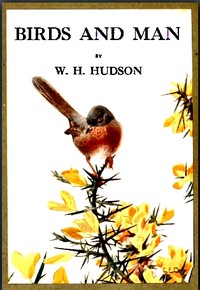
Birds and Man — A Reader’s Guide
(0 User reviews)
602
Project Gutenberg
2011
Not confirmed
Birds
Readers of public-domain and historical texts
Project Gutenberg digital edition
en
Edition facts
Words
72,399
Reading time
315 min
Text sections
11
The source record for Birds and Man — A Reader’s Guide measures this digital text at 72,399 words, 5 hr 15 min estimated reading time, and 11 detected text sections.
The text analysis averages about 34.0 words per sentence, while the detected sections provide another way to judge how the source is divided.
Project Gutenberg metadata also associates the work with “Birds,” connecting these edition facts with the source record’s subject description.
Source:
Project Gutenberg record #37787
Hudson examines the relationship between humans and birds through precise observations of ravens, wagtails, and other species, critiquing taxidermy and exploring the psychological gulf between people and small birds.
Read the complete public-domain text at its original source.
Read on Project GutenbergHudson opens Birds and Man by recalling his visceral distaste for stuffed birds displayed in glass cases, describing the artificial surroundings as 'matter out of place' with a 'grimy and depressing appearance.' This aversion to taxidermy sets the tone for a work that insists on observing living birds in their natural settings. Hudson’s prose is direct and opinionated, as when he dismisses the taxidermist’s 'bastard art' for producing only 'sensations of irritation and disgust.'
The author’s voice is that of a naturalist who values firsthand experience over preserved specimens. He contrasts the 'life-imitating attitude' of a stuffed bird with the vanished 'passion and the life whose fountains are within,' a phrase that underscores his commitment to capturing the animate essence of birds.
The Wagtail and the Raven: Scale and Sympathy
Hudson engages with a paradox: why might a person on a desert island prefer ravens to wagtails? He cites a Mr. Fowler, who claims that wagtails alone would suffice for company, but Hudson disagrees. For him, the 'vast gulf' between humans and small birds is psychological; he quotes Matthew Arnold’s line that birds 'live beside us, but unknown' to argue that we cannot find 'passages from our souls to theirs.' The raven, by contrast, possesses a 'more mammal-like, and therefore more human-like, mind.'
This distinction is not mere speculation. Hudson grounds it in his own observation of a pair of ravens disturbed by his presence on a cliff. He notes their 'angry, deep croak' and their method of descent: 'a series of long drops with closed wings,' a feat he links to strong winds. The ravens’ anxiety stems from annual nest-plundering by 'the cursed collector,' a phrase Hudson borrows from Sir Herbert Maxwell. By tying the birds’ behavior to human persecution, he makes the psychological gulf a matter of shared experience, not just size.
The Texture of Description: Diction and Detail
Hudson’s descriptive choices reveal a writer attentive to the sensory and the specific. He describes the ravens as 'big and solemn, and solemn and big,' a repetition that mimics the birds’ ponderous presence. Their flight is rendered with precision: they 'allow the wind to lift them higher and higher until they would look no bigger than daws.' The comparison to daws (jackdaws) gives scale, while the passive construction 'allow the wind' emphasizes the birds’ mastery of air.
His critique of taxidermy cases is equally vivid: the floor is made of 'sand, rock, clay, chalk, or gravel,' each material 'invariably' looking grimy. The miniature bushes are 'made of tin or zinc and then dipped in a bucket of green paint.' Such details are not decorative; they serve Hudson’s argument that artifice cannot replicate life. The 'crystal globes' put into stuffed birds’ sockets 'shoot forth no life-like glances,' a phrase that contrasts dead glass with the living eye.
Structure and Argument: From Aversion to Affection
The chapter 'Birds at their Best' functions as an introduction, but its structure is more essayistic than prefatory. Hudson begins with a strong personal reaction—disgust at taxidermy—then pivots to a broader meditation on why we value certain birds over others. He uses the wagtail-versus-raven debate to explore how proximity and rarity shape our perceptions. In 'an England from which most of the larger birds have been banished,' he argues, we become absorbed in small species because they are 'nearest to us.'
This argument is not linear. Hudson moves from his cliff-top vigil to a reflection on Matthew Arnold, then back to the ravens’ aerial display. The shifts mimic the associative logic of a naturalist’s mind, where a single observation sparks a chain of thought. The chapter ends not with a conclusion but with a description of the ravens’ descent, leaving the reader to weigh the evidence. This open-endedness is characteristic of Hudson’s method: he presents his experience and trusts the reader to draw their own inferences.
Voice and Authority: The Naturalist as Critic
Hudson’s authority derives not from scientific credentials but from the candor of his observations. He admits when he was wrong: 'That, in the last clause, was wrongly writ,' referring to his earlier statement about taxidermy. This self-correction is rare in nature writing and lends credibility. He also names his sources—Mr. Fowler, Sir Herbert Maxwell, Matthew Arnold—situating himself within a community of observers and thinkers.
His tone is conversational yet precise. He uses the first person freely ('I spent so long a time in watching') and addresses the reader directly ('try how we will we can find no passages'). The prose is rhythmically varied: short declarative sentences ('Big and solemn, and solemn and big, they certainly were') alternate with longer, more complex constructions. This variety keeps the reader engaged while conveying the texture of Hudson’s thought. His judgments are firm but not dogmatic, as when he calls the collector 'the worst enemy' but immediately adds that another enemy 'is really worse.'
Hudson’s Birds and Man rewards readers who attend to the interplay of observation and reflection. The excerpts reveal a writer who uses precise diction and structural shifts to explore how we perceive and value birds. Pay attention to his self-revisions and his willingness to challenge received ideas, such as the notion that small birds are inherently more companionable. Hudson’s authority rests on the honesty of his account, not on any claim to completeness.
That rainy afternoon, Hudson’s quiet fury over a stuffed raven made me set the book down, staring at the dripping window. His precise, tender disdain for that gilded corpse lingered oddly. Then my hand drifted, almost on its own, to Birds of the Rockies — A Reader’s Guide, and I remembered the same ache for wildness, left alone, unrung. It felt like finding an old letter.
There are no reviews for this eBook.
There are no comments for this eBook.
Reader reflection
Before you leave, reflect on the book
Use these questions to collect your thoughts before moving on.
Your progress
0
/
10
2
How did the book work for you overall?
3
How likely are you to recommend this book?
4
Did the language feel accessible?
5
How distinctive were its ideas or approach?
6
How useful did the reading feel?
7
How understandable was the text?
8
How well did it match your expectations?
9
What changed or sharpened your thinking?
10