1

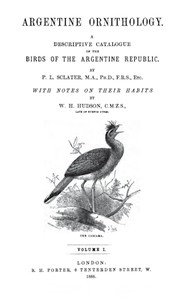
Argentine Ornithology, Volume 1 (of 2) A descriptive catalogue of the birds of the Argentine Republic. — Reading Companion
(0 User reviews)
781
Project Gutenberg
2012
Not confirmed
Birds -- Argentina
Readers of public-domain and historical texts
Project Gutenberg digital edition
en
Edition facts
Words
98,725
Reading time
430 min
Text sections
18
The catalog record for Argentine Ornithology, Volume 1 (of 2) A descriptive catalogue of the birds of the Argentine Republic. — Reading Companion provides practical reading context through 98,725 words, 7 hr 10 min estimated reading time, and 18 detected text sections.
The text analysis averages about 14.1 words per sentence, while the detected sections provide another way to judge how the source is divided.
Project Gutenberg metadata also associates the work with “Birds -- Argentina,” connecting these edition facts with the source record’s subject description.
Source:
Project Gutenberg record #38956
This volume catalogs 229 passerine species of Argentina, combining Sclater's scientific descriptions with Hudson's field observations on behavior, song, and nesting. The work's structure alternates between formal taxonomy and vivid natural-history notes, revealing the authors' complementary approaches.
Read the complete public-domain text at its original source.
Read on Project GutenbergThis volume opens with a striking structural duality: Philip Lutley Sclater provides the scientific nomenclature and systematic arrangement, while W. H. Hudson contributes field observations on habits and behavior. The preface makes clear that all personal observations are Hudson's, and Sclater is responsible for the scientific portions. This division of labor shapes every page, as formal descriptions of plumage and measurements sit alongside Hudson's vivid accounts of bird behavior, often drawn from his long residence near Buenos Ayres.
The work is limited to 200 signed copies, a fact that underscores its intended audience of specialists and subscribers. Yet the content reaches beyond dry taxonomy: Hudson's notes frequently include anecdotes, local names, and even disputes among early naturalists, such as the controversy between Azara and Noseda over the parasitic habits of the Cow-bird.
Taxonomy and Lived Observation
The book's structure alternates between two distinct modes. Each species entry begins with a technical heading: Latin binomial, authority, and often a citation to the Catalogue of Birds or other references. Then follows a concise physical description—measurements of total length, wing, and tail, plus coloration of plumage, bill, and feet. But immediately after, Hudson's voice takes over with paragraphs on habitat, song, and behavior. For example, the entry for the Chopi (a blackbird) moves from a dry description to a detailed account of its aggressive defense against enemies, its dawn song from rooftops, and its nesting habits. This juxtaposition creates a rhythm of formal science and lived natural history.
Recurring Images: Song and Warning
Across the excerpts, bird song and alarm calls appear as recurring motifs. The Chopi is described as having a 'loud whistle' that warns other birds of danger, followed by a 'victorious song' beginning with its own name. The Urraca Jay possesses 'a great variety of peculiar grating metallic notes.' These descriptions emphasize not just the sounds but their social function: warning, territorial display, or greeting the dawn. Hudson often notes where and when birds sing—from eaves, in captivity, or during the pairing season. This attention to vocal behavior gives the catalogue a dynamic, auditory dimension, as if the reader is meant to hear the birds as well as see them.
Movement Between Scenes: From Pampas to Sierras
The text moves fluidly between different Argentine landscapes. Hudson's notes reference specific locations: Campo Colorado (Salta), the sierras of Totoral, Tucuman, Catamarca, and the woods of northern provinces. The Azure Jay is noted from Misiones, while the Patagonian Mockingbird appears in the south. This geographic range is not merely listed but evoked through brief scene-setting: the Blue Jay is 'very common about the woods' and 'remarkably tame and inquisitive'; the Chopi roosts on 'eaves and tiled roofs of houses.' The reader travels from domestic settings to remote sierras, from the pampas to the northern forests, often within a single page.
The Naturalist's Dispute as Scientific Drama
One of the most striking passages recounts a controversy between Azara and his friend Noseda over whether the Cow-bird is parasitic. Noseda insisted that the Cow-bird was merely the year-old young of the Chopi, taking three years to mature. Azara offered five objections, any one of which, Hudson notes dryly, 'would be sufficient to demolish it.' This episode reveals the work's willingness to include scientific debate and even error, treating natural history as an evolving, argumentative discipline. Hudson does not simply present facts; he shows how knowledge was contested, with Azara's careful observation eventually winning out. Such moments give the catalogue a human, narrative interest beyond its taxonomic purpose.
Readers approaching this volume should expect to move between two voices: Sclater's concise taxonomy and Hudson's expansive field notes. The work rewards those who read not just for identification but for the stories embedded in the descriptions—the disputes, the habits, the sounds of birds in specific Argentine places. Because the excerpts cover only the Passeres, the full picture of Argentine bird life awaits the second volume, which promises to treat the remaining orders.
That rainy afternoon, Hudson’s notes on the chaco finch’s hidden nest felt like a secret whispered between strangers. Later, I idly opened The Bird Book Illustrating in natural colors more than seven hundred North American birds; also several hundred photographs of their nests and eggs. — Themes and Context, and the same quiet patience stared back from its plates—another continent, same hush.
There are no reviews for this eBook.
There are no comments for this eBook.
Reader reflection
What was your reading experience?
Capture what you thought, learned, and would like to remember.
Your progress
0
/
10
2
Was reading this book enjoyable?
3
Would you recommend this book to another reader?
4
Did the language feel accessible?
5
Which aspect of the book did you value most?
6
Did this book create an emotional response?
7
How would you describe its reading pace?
8
Would you read this book again?
9
What did this book teach you most?
10