
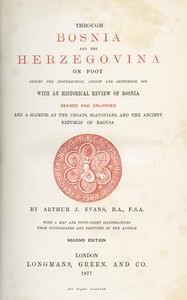
Through Bosnia and the Herzegóvina on foot during the insurrection, August and…
Okay, let's set the scene. It's the summer of 1875. A massive peasant revolt has just exploded across Bosnia and Herzegovina against Ottoman rule. The newspapers in London are full of confusing reports. Into this chaos walks (literally) a 24-year-old Arthur Evans. Yes, the Arthur Evans who would later become famous for discovering the Minoan palace of Knossos. But here, he's just a curious, brave, and slightly reckless traveler with a notebook.
The Story
This isn't a plotted novel, but the journey itself creates the narrative. Evans and his guide trek across mountains and through valleys, often following paths just abandoned by fleeing troops. He doesn't stay in hotels; he sleeps in monasteries that double as forts, shares meals with village headmen, and interviews everyone from rebel leaders to terrified farmers. He describes landscapes of stunning beauty right next to scenes of recent devastation—burned homes, abandoned fields. The 'action' is in the conversations: hearing firsthand why people took up arms, feeling the thick suspicion directed at a foreigner, and witnessing the complex mix of desperation and hope that fuels an uprising.
Why You Should Read It
What grabbed me was the immediacy. Evans isn't a distant historian analyzing events decades later. He's there while the gunpowder is still in the air. His observations are sharp, human, and sometimes uncomfortably frank for a Victorian gentleman. You get the gritty reality behind the political headlines—the mud, the fear, the awful calculus of survival. It completely shatters any romantic notion of 'noble rebellion.' More than that, it's a fascinating portrait of the writer himself. You see the seeds of the great archaeologist in how he meticulously records details, from folk songs to the architecture of a damaged church. He's building a picture of a living culture under extreme stress.
Final Verdict
Perfect for readers who love immersive travel writing or raw historical primary sources. If you enjoyed the on-the-ground feel of books like Dispatches by Michael Herr, but set in the 19th century, you'll be captivated. It's also a must for anyone trying to understand the deep, tangled roots of Balkan history. Fair warning: it's not a light, easy escape. It's a challenging, sobering, and utterly transporting walk through a pivotal moment in time, led by a guide who makes you feel every step of the way.
This is a copyright-free edition. Use this text in your own projects freely.
Carol Perez
1 year agoThe layout is very easy on the eyes.
Thomas Walker
1 year agoI have to admit, the flow of the text seems very fluid. Exactly what I needed.
Kevin Lewis
1 year agoHelped me clear up some confusion on the topic.
Michael Lee
1 year agoSurprisingly enough, the narrative structure is incredibly compelling. I will read more from this author.








Lisa Robinson
2 years agoJust what I was looking for.