
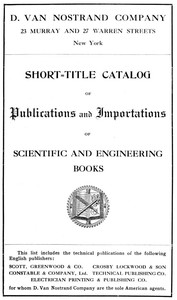
Short-Title Catalog of Publications and Importations of Scientific and…
Let's be clear from the start: this is not a novel. Short-Title Catalog of Publications and Importations of Scientific and… is exactly what the title says—a reprinted sales catalog from a major 19th-century publisher. There's no plot twist or climax. Instead, the "story" it tells is one of intellectual hunger. Published in 1869, this catalog lists every scientific, technical, and educational book D. Van Nostrand had for sale or was bringing in from Europe.
The Story
The narrative here is in the collection itself. Flipping through the pages (or scrolling through a digital copy), you travel from agriculture and architecture, through chemistry and civil engineering, all the way to zoology. You see the bedrock of a rebuilding nation: manuals on bridge construction, railroad engineering, and telegraphy. But you also see the frontiers of thought—early works on evolution, new discoveries in geology, and advanced mathematics. It’s the inventory of a country's brainpower, a checklist for building a modern world from the ground up.
Why You Should Read It
I loved this for the unexpected human connection. You stop seeing a dry list and start seeing choices. What did a young engineer in 1869 need to study? What book would a doctor order to stay current? The catalog reveals what knowledge was considered essential, what was newly exciting, and what was being imported because America didn't produce it yet. It’s strangely personal. You can imagine the ink-stained fingers of shop clerks filling these orders, the excitement of receiving a shipment of European journals, and the weight of these books in the hands of people shaping the future. It turns history from a series of events into a tangible, bookish reality.
Final Verdict
This is a niche read, but a deeply rewarding one. It's perfect for history buffs who enjoy primary sources, for bibliophiles fascinated by the book trade, or for anyone in STEM fields curious about their professional roots. It’s not a page-turner; it’s a browser. Keep it on your tablet or desk, dip in for ten minutes, and let your curiosity wander. You won't get a traditional story, but you'll get something better: a direct line to the curious, ambitious, and pragmatic spirit of 1869.
This publication is available for unrestricted use. It is now common property for all to enjoy.
Kenneth Johnson
1 year agoI have to admit, the author's voice is distinct and makes complex topics easy to digest. Worth every second.
Margaret Flores
2 years agoThis book was worth my time since the character development leaves a lasting impact. Exactly what I needed.
Melissa Flores
4 months agoI didn't expect much, but the narrative structure is incredibly compelling. One of the best books I've read this year.
Kimberly Johnson
1 year agoCompatible with my e-reader, thanks.
Betty Scott
1 year agoNot bad at all.