
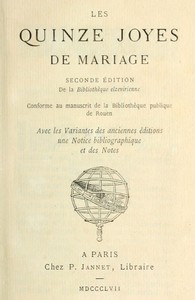
Les quinze joyes de mariage by Antoine de La Sale
Let's be clear from the start: the 'joys' in the title are about as joyful as a rainy festival. Antoine de La Sale's book is a collection of fifteen short stories, each one showing a different way a husband's life can be made miserable after tying the knot. We're talking about the late Middle Ages here, but you'll recognize the patterns immediately.
The Story
The book doesn't follow one plot. Instead, it's like a medieval manual of marital pitfalls. Each 'joy' is a standalone scene. In one, a wife pretends to be gravely ill to manipulate her husband into buying her expensive gifts. In another, a young bride spends her husband into poverty, always needing the latest fashions. Another shows a wife using religion as a tool for control, insisting on constant pilgrimages that drain the family coffers. The husbands are almost always the same character: a decent, hardworking man who is slowly worn down by his wife's constant demands, tricks, and emotional games. There's no grand adventure or battle—the war is in the home, and the husbands are losing.
Why You Should Read It
First, it's hilarious in a very dry, ancient way. The humor comes from watching these men walk straight into traps that are obvious to everyone but them. It's a masterclass in comic timing from the 1400s. Second, it's a fascinating historical document. This isn't a king's chronicle or a religious text; it's about everyday people and their petty struggles. You get a real sense of what worried ordinary folks—money, social status, household power. It shows that the battle of the sexes is nothing new. The book is also incredibly short and easy to dip in and out of. Each 'joy' is a quick, self-contained bite of medieval life.
Final Verdict
This book is perfect for anyone who loves historical stuff but is tired of swords and politics. If you enjoy satire—like Chaucer's Canterbury Tales—you'll feel right at home. It's also great for people curious about social history and the surprisingly timeless nature of human relationships. Fair warning: it's deeply misogynistic by modern standards. The women are all schemers, and the men are all fools. Read it not as truth, but as one grumpy old writer's very opinionated, very funny take on the world. It's a short, sharp, and cynical peek behind the curtain of medieval domestic life.
There are no legal restrictions on this material. It serves as a testament to our shared literary heritage.
Deborah Young
1 year agoA must-have for anyone studying this subject.
Barbara Allen
1 year agoHigh quality edition, very readable.
Lisa Rodriguez
2 years agoSolid story.
Kimberly Wright
1 year agoI came across this while browsing and it manages to explain difficult concepts in plain English. Absolutely essential reading.




Logan Jones
7 months agoI started reading out of curiosity and the plot twists are genuinely surprising. Don't hesitate to start reading.