1

The Living Animals of the World, Volume 2 (of 2) A Popular Natural History — Reading Companion
(0 User reviews)
348
Project Gutenberg
2019
Not confirmed
Animals; Zoology
Readers of public-domain and historical texts
Project Gutenberg digital edition
en
Edition facts
Words
176,699
Reading time
769 min
Text sections
37
The Living Animals of the World, Volume 2 (of 2) A Popular Natural History — Reading Companion can be approached with a clearer sense of reading commitment from its source measurements: 176,699 words, 12 hr 49 min estimated reading time, and 37 detected text sections.
The text analysis averages about 22.2 words per sentence, while the detected sections provide another way to judge how the source is divided.
Project Gutenberg metadata also associates the work with “Animals,” connecting these edition facts with the source record’s subject description.
Source:
Project Gutenberg record #60718
This editorial note examines the descriptive strategies in a multi-contributor natural history volume, focusing on how the authors blend anatomical precision, behavioral observation, and anecdotal evidence in their accounts of birds, reptiles, and fishes.
Read the complete public-domain text at its original source.
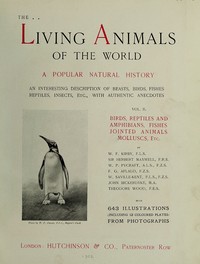
Read on Project GutenbergThe second volume of The Living Animals of the World opens with a striking photograph of a cassowary, the caption noting that the female is larger and equally brilliant in colouring—a detail that immediately signals the work’s attention to sexual dimorphism and visual documentation. This volume, covering birds, reptiles, amphibians, fishes, and invertebrates, relies on a collaborative authorship of six naturalists, each bringing a distinct voice. The result is a text that shifts between dry taxonomic description, vivid habitat sketches, and occasional dramatic anecdotes, all anchored by over six hundred photographs and plates. The editorial challenge is to assess how these varied approaches serve the stated aim of a “popular natural history.”
Diction Between Scientific and Popular Registers
The contributors move fluidly between technical terminology and accessible language. In the account of the anaconda, the reader encounters phrases like “transversely disposed rows of large, rounded, dark brown or blackish spots” alongside the claim that the snake “had devoured a horse.” The juxtaposition is deliberate: the precise description of scale patterns satisfies the naturalist, while the anecdote of a horse-eating monster appeals to a general audience. Elsewhere, the text explains the absence of the “coronoid” bone in common snakes, a detail that would be lost on most casual readers, yet it is presented without apology. This uneven register suggests the editors assumed a readership willing to engage with some anatomical jargon, perhaps drawn by the illustrations and the promise of authentic anecdotes.
The Role of Anecdote in Conveying Behavior
Anecdotes serve as the primary vehicle for behavioral description. The anaconda entry includes a secondhand report from Dr. Gardiner’s travels, describing a snake found dead after swallowing a horse. The source is named, lending credibility, but the event is not verified by the authors. Similarly, the text states that anacondas “are alleged to fall victims” to cattle and humans, using cautious language that distances the authors from the claim. This pattern recurs throughout: the contributors present dramatic incidents—a snake lying in wait with only its head above water, a python coiling on tree branches—but often attribute them to unnamed observers or earlier writers. The effect is a hybrid of natural history and travel narrative, where the authority of the authors rests on their selection and framing of others’ reports.
Visual Evidence and Descriptive Precision
The volume’s 643 illustrations, including twelve colour plates, are integral to its method. Photographs are credited to individuals such as W. P. Dando and H. G. F. Spurrell, indicating a network of specialist photographers. The captions often add behavioural or morphological notes, as with the cassowary’s size and colour. In the snake section, photographs of a leopard-snake and a tesselated snake are accompanied by brief remarks on their harmlessness and European distribution. The written descriptions frequently mirror the visual evidence: the anaconda’s “greyish brown or olive” ground colour and “eye-like spots” are rendered in words that could serve as a key to the photograph. This coordination between image and text suggests that the authors expected readers to study the plates closely, using the prose as a guide to identification.
Structure and Classification as Narrative Framework
The book’s organisation follows a taxonomic hierarchy, moving from birds through reptiles to fishes, with each class divided into families and genera. Within this framework, the authors occasionally disrupt the systematic progression with comparative remarks. For instance, the shield-tails are described as “an interesting little group, connecting the Boas and Pythons with the Common Snakes,” highlighting evolutionary relationships without using the term evolution. The text also notes that the characters separating snake families “are not readily recognised without having recourse to dissection,” acknowledging the limits of field observation. This structural choice—placing technical classification alongside practical identification tips—reflects the volume’s dual audience: the amateur naturalist who wants to name what they see, and the more serious student who seeks underlying anatomical principles.
Readers approaching this volume should attend to the interplay between its systematic arrangement and the digressive anecdotes that enliven the prose. The photographs reward close study, often revealing details that the text amplifies or explains. Because the work is a collaboration, the tone and depth vary by chapter; some sections lean heavily on technical description, while others favour narrative. Treating the book as a curated collection of observations rather than a unified treatise allows the reader to appreciate the distinct voices of its six contributors and the era’s natural history publishing conventions.
This volume’s careful watch over scales and feathers brought back a quiet afternoon, thumbing through plates of beasts I’d only met in dreams. The same unhurried patience lived in Natural History of the Mammalia of India and Ceylon — A Reader’s Guide. Both books felt like old friends explaining the world softly, one creature at a time, without hurry.
There are no reviews for this eBook.
There are no comments for this eBook.
Reader reflection
Record your reading impressions
A brief reflection can help important ideas stay with you longer.
Your progress
0
/
10
2
What was your overall reaction to the book?
3
How likely are you to recommend this book?
4
How demanding did the text feel?
5
Which element worked best for you?
6
Did it raise ideas you would like to talk about?
7
How understandable was the text?
8
Did the book deliver what you hoped for?
9
In one sentence, what did you learn?
10