
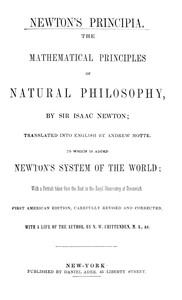
Newton's Principia : The mathematical principles of natural philosophy by Newton
Let's be clear upfront: this is not a beach read. Newton's Principia is one of the most important and challenging books ever written. But its story is simple to tell. Before 1687, our understanding of motion and the heavens was a messy mix of philosophy, guesswork, and ancient ideas. Planets wandered in complicated loops. No one could explain why.
The Story
Newton changed all that. He didn't just describe what he saw; he built a new mathematical framework. The book lays out his three laws of motion (think: an object at rest stays at rest, and for every action there's an equal reaction) and his law of universal gravitation. He then uses these tools, with incredible geometric proofs, to solve big puzzles. He shows how the same force that pulls an apple to the ground keeps the moon in orbit. He explains the tides, the paths of comets, and the slight wobble in Earth's axis. The plot is the triumph of a single, unified system over centuries of confusion.
Why You Should Read It
You don't read this to get an A in physics. You read it to feel the seismic crack of a genius idea. There's a raw power in watching Newton connect dots no one else even saw. It's humbling. The prose is dense and the math is archaic, but peeking through is a mind so confident it dared to codify the mechanics of the entire universe. It's the ultimate 'show your work' notebook. Reading even parts of it makes you appreciate the sheer audacity of the project. This book didn't just add to knowledge; it created a new way of knowing.
Final Verdict
This book is for the intellectually curious who want to touch the source. It's perfect for science and history lovers who've read a dozen about Newton and are ready to brave the original, even if just in small doses. It's for anyone who gets a thrill from seeing a foundational text, warts and all. Don't expect a smooth narrative—expect to wrestle with genius. Keep a modern guide or summary handy, and prepare to be amazed by how much of our world started right here, in these pages.
This book is widely considered to be in the public domain. Use this text in your own projects freely.
Jackson Clark
10 months agoFrom the very first page, it provides a comprehensive overview perfect for everyone. Exceeded all my expectations.
Kimberly Lewis
5 months agoI stumbled upon this title and the plot twists are genuinely surprising. Don't hesitate to start reading.
Linda Sanchez
1 year agoAmazing book.
Barbara Anderson
5 months agoAfter hearing about this author multiple times, the pacing is just right, keeping you engaged. Absolutely essential reading.
Anthony Brown
1 year agoVery interesting perspective.