
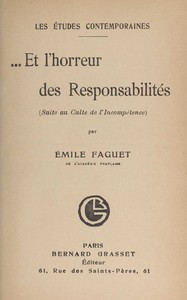
... Et l'horreur des responsabilités (suite au Culte de l'incompétence) by Faguet
This book isn't a novel with a plot in the traditional sense. Think of it more as a brilliantly argued, deeply frustrated essay. It picks up right where Faguet's previous work left off. He already made his case that society was developing a strange admiration for incompetence. In this sequel, he explores the terrifying consequences of that trend.
The Story
There's no protagonist or villain, unless you count bad ideas themselves. Faguet paints a picture of a political world where the most important jobs go to the least capable people. He argues that when you have a 'cult' that worships being unskilled, the natural result is a deep fear and avoidance of real responsibility. Why? Because responsibility requires competence, and competence is exactly what this system rejects. He walks us through how this plays out in government, in public administration, and in the general morale of a nation. The 'horror' he describes is the slow, grinding failure of everything—from trains not running on time to larger national crises—because no one in charge feels truly accountable or has the skill to fix things.
Why You Should Read It
Here's the wild thing: it was written in 1914, but it doesn't feel old. It feels urgent. When Faguet complains about politicians who care more about popularity than results, or bureaucracies that exist to sustain themselves rather than serve the public, you'll be nodding along. His writing is sharp, clear, and often sarcastic. He's not a dry academic; he's a critic who's had enough, and his passion bleeds through every page. Reading him is like getting a masterclass in connecting societal symptoms to their root causes. It gives you a vocabulary for frustrations you might feel but haven't fully articulated.
Final Verdict
This is a perfect book for anyone who loves political philosophy, history, or current affairs and enjoys a direct, no-nonsense argument. It's for the reader who looks at the news and wonders, 'How did we get here?' Faguet offers a century-old answer that still rings true. It's also a great, short read for students of history or political science who want to see how people of the past diagnosed the problems of their own time. Fair warning: it's pessimistic. But sometimes, a clear-eyed dose of pessimism from a brilliant mind is exactly what you need to understand the world a little better.
Legal analysis indicates this work is in the public domain. Share knowledge freely with the world.
Kenneth Sanchez
3 months agoI started reading out of curiosity and the plot twists are genuinely surprising. Definitely a 5-star read.
Michael Taylor
1 year agoThanks for the recommendation.






Robert Jackson
6 months agoComprehensive and well-researched.