1

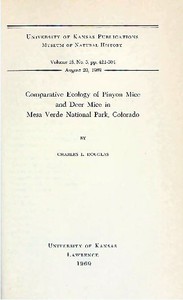
Comparative Ecology of Pinyon Mice and Deer Mice in Mesa Verde National Park, Colorado — Background and Themes
(0 User reviews)
730
Project Gutenberg
2012
Not confirmed
Mammals -- Colorado -- Mesa Verde National Park; Piñon mouse; Peromyscus maniculatus; Mammals -- Behavior
Readers of public-domain and historical texts
Project Gutenberg digital edition
en
Edition facts
Words
35,664
Reading time
156 min
Text sections
6
For Comparative Ecology of Pinyon Mice and Deer Mice in Mesa Verde National Park, Colorado — Background and Themes, the stored edition analysis reports 35,664 words, 2 hr 36 min estimated reading time, and 6 detected text sections.
The text analysis averages about 15.5 words per sentence, while the detected sections provide another way to judge how the source is divided.
Project Gutenberg metadata also associates the work with “Mammals -- Colorado -- Mesa Verde National Park,” connecting these edition facts with the source record’s subject description.
Source:
Project Gutenberg record #38959
A 1969 ecological study comparing two Peromyscus species in Mesa Verde National Park, analyzing home range, habitat preference, reproduction, growth, and behavior through trapping and observation.
Read the complete public-domain text at its original source.
Read on Project GutenbergCharles L. Douglas's 1969 monograph, published as part of the University of Kansas Museum of Natural History series, presents a detailed field comparison of two sympatric rodent species—the pinyon mouse (Peromyscus truei) and the deer mouse (Peromyscus maniculatus)—within the pinyon-juniper woodlands of Mesa Verde National Park, Colorado. The study draws on trapping data, vegetational analysis, and captive observations to examine how these closely related species partition resources and respond to the same environment.
Douglas opens by noting that prehistoric Pueblo inhabitants depicted mammals on pottery and kiva walls, and that faunal remains from archaeological sites suggest the same species present today. This historical continuity frames the ecological inquiry, grounding modern field data in a long-term context.
Contrasting Home-Range Patterns
Douglas calculated home ranges using both inclusive and exclusive boundary strip methods, revealing species-specific differences. For P. truei, the mean home range was approximately 0.76 acres (inclusive) and 0.41 acres (exclusive), while P. maniculatus ranged over 0.99 and 0.55 acres, respectively. The adjusted length of home range—a measure of linear movement—also differed: 323 feet for pinyon mice versus 388 feet for deer mice.
These figures suggest that deer mice travel farther, possibly reflecting broader habitat use. However, Douglas cautions that trap-revealed ranges may underestimate actual movements, especially for individuals that appear sporadically. The data also show considerable individual variation, with some mice captured only once or twice, limiting the precision of range estimates.
Reproductive Timing and Environmental Cues
Douglas tracked reproductive condition through external examination of testes and palpation of embryos. He found that not all adult males reached breeding condition simultaneously: some with abdominal testes in mid-July became scrotal as late as September. Juvenal males occasionally showed scrotal testes during postjuvenal molt, but most did not breed in their first summer.
He hypothesized that cooler evening temperatures in July and August, associated with higher precipitation, might inhibit reproductive development in late-born young. The observation that early-born young may reproduce later the same season, while late-born ones delay until the following year, points to a possible adaptive response to seasonal resource availability. Douglas acknowledges the difficulty of following non-captive individuals and notes that his data do not support a firm conclusion.
Growth Rates and Regional Variation
Captive litters of both species were measured from birth to 70 days. Douglas found that solitary young grew faster than those with littermates, yet all reached similar adult size by about 50 days. Figures 18 and 19 show scatter diagrams of body length increase, with P. maniculatus individuals (17 from four litters) and P. truei (11 from five litters) plotted separately.
Douglas emphasizes that ecological data from California populations (McCabe and Blanchard, 1950) do not apply directly to Colorado subspecies: preferred habitats and behavior differ strikingly. This caution underscores the importance of local study. The growth curves, while not amenable to statistical confidence limits due to irregular measurement intervals, provide a baseline for comparing developmental rates between the two species in this specific environment.
Douglas's work offers a meticulous, site-specific account of how two similar rodent species coexist in a semi-arid landscape. Readers interested in small-mammal ecology will find detailed methodological descriptions—such as the use of inclusive versus exclusive boundary strips for home-range calculation—that invite critical evaluation. The study's strength lies in its integration of trapping, vegetation, microclimate, and captive data, though Douglas himself notes the limitations imposed by sporadic recaptures and small sample sizes. This monograph is best approached as a primary research document rather than a synthesis, rewarding careful attention to its tables and figures.
Reading about the pinyon mice’s careful home ranges in Mesa Verde, I found myself drifting to another quiet study, the one on Michigan’s Gogebic and Ontonagon counties. Both share that patient, unhurried attention to small lives. It made me recall a grey afternoon, turning pages, feeling the same respectful stillness, as if those old observations were simply waiting for someone to remember them. Notes on the Mammals of Gogebic and Ontonagon Counties, Michigan, 1920 Occasional Papers of the Museum of Zoology, Number 109 — Background and Themes holds that same gentle, patient quality.
There are no reviews for this eBook.
There are no comments for this eBook.
Reader reflection
Before you leave, reflect on the book
Use these questions to collect your thoughts before moving on.
Your progress
0
/
10
2
Was reading this book enjoyable?
3
Would you encourage someone else to read it?
4
Did the language feel accessible?
5
Did you relate to its people, ideas, or situations?
6
Did the book meet your expectations?
7
Did you gain anything practical from the text?
8
Did the book offer a fresh perspective?
9
In one sentence, what did you learn?
10






![Cover of The zoology of the voyage of H.M.S. Beagle [vol. 1 of 5] — A Reader’s Guide](https://siqeq.com/storage/media/covers/pg68925.jpg)
![Cover of The zoology of the voyage of H.M.S. Beagle [vol. 2 of 5] — Inside the Classic](https://siqeq.com/storage/media/covers/pg69577.jpg)