
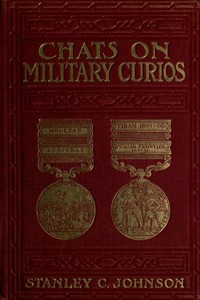
Chats on Military Curios by Stanley C. Johnson
The Story
Imagine your grandfather’s box of junk bits from army days — bayonets, badges, musket balls — but someone explains exactly what each one meant to the soldier who carried it. That’s this book. Stanley Johnson writes like your clever neighbor who genuinely wants you to care about his hobby. There’s no big plot, just a slow wander through glass cases of miniature uniforms, rare swords, medals you’ve never heard of, and even tiny liquor flasks engraved with regiments. But hidden in each item is a mini-novel: a code of conduct for British officers, the medal earned by surviving a deadly tropical war, how a simple powder flask balanced two centuries of firearms. Johnson’s real secret is learning how to see hidden histories you never knew existed.
Why You Should Read It
Reading this is like going antiquing with a professor who buys you coffee and spills gossip about Lord Kitchener’s favorite gear. Johnson treats readers like equals, not students. He doesn’t lecture — he gets downright excited over the copper wire of an Indian Mutiny medal and proves World War I field gear is incredibly logical. I laughed at himself for praising a truly ugly Victorian hat, then suddenly understood why soldiers wore them. The book zeroes in on why regular people collect military junk, not just experts. It made me go hunt for boxes at vintage stores. For someone like me — a nerd who gets tired of dry textbook writing — this one’s juice. Johnson sees art and humble creativity where others see trash.
Final Verdict
Open this if you’re a hobbyist collector, a military history beginner, or someone who enjoyed watching genuine curiosity from a thoughtful guide. The writing pops like summer conversation, so skip the book if you need strict modern catalog formats — it drifts gracefully from one curious weapon to another. Perfect for a cozy rainy blanket, tea stained pages, and puzzling over whether those belt buckles witnessed the Indian frontier or a parade ground. Johnson turns "historic junk" into something beautiful and worth saving.
This work has been identified as being free of known copyright restrictions. Preserving history for future generations.
Joseph Rodriguez
6 months agoSolid information without the usual fluff.
Richard Thompson
2 years agoHaving explored several resources on this, I find that the structural organization allows for quick referencing of key points. Simple, effective, and authoritative – what else could you ask for?
Emily Anderson
5 months agoMy first impression was quite positive because the objective evaluation of the pros and cons is very refreshing. This adds significant depth to my understanding of the field.
Charles Miller
2 months agoOne of the most comprehensive guides I've read this year.

Nancy Moore
9 months agoUnlike many other resources I've purchased before, the step-by-step breakdown of the methodology is extremely helpful for students. An excellent example of how quality digital books should be formatted.