1

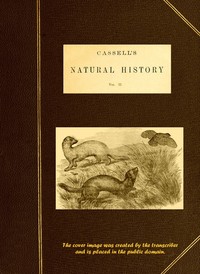
Cassell's Natural History, Vol. 2 (of 6) — Key Ideas to Explore
(0 User reviews)
65
Project Gutenberg
2019
Not confirmed
Animals; Animal behavior; Zoology
Readers of public-domain and historical texts
Project Gutenberg digital edition
en
Edition facts
Words
217,878
Reading time
948 min
Text sections
136
Before opening Cassell's Natural History, Vol. 2 (of 6) — Key Ideas to Explore, the edition data offers a quick orientation: 217,878 words, 15 hr 48 min estimated reading time, and 136 detected text sections.
The text analysis averages about 25.3 words per sentence, while the detected sections provide another way to judge how the source is divided.
Project Gutenberg metadata also associates the work with “Animals,” connecting these edition facts with the source record’s subject description.
Source:
Project Gutenberg record #59906
This editorial note examines the descriptive strategies and structural tensions in the second volume of Cassell's Natural History (1896), focusing on how the text balances scientific classification with vivid, anecdotal observations of carnivores.
Read the complete public-domain text at its original source.
Read on Project GutenbergThe second volume of Cassell's Natural History (1896) opens a window into late-Victorian zoological writing, where rigorous classification coexists with lively, sometimes startling, natural-history anecdotes. Edited by P. Martin Duncan, the volume covers terrestrial and aquatic carnivores, cetaceans, sirenians, proboscideans, hyraxes, and ungulates. The excerpts reveal a persistent tension between the authors' commitment to systematic taxonomy—dividing carnivores into Fissipedia and Pinnipedia, for instance—and their evident delight in recording peculiar behaviors, striking coloration, and the animals' interactions with humans. This note traces three patterns visible in the supplied text: the use of visual and behavioral contrasts to define species, the interplay between anatomical description and narrative observation, and the subtle ways the authors acknowledge gaps in contemporary knowledge.
Contrast as a Descriptive Tool
The authors frequently employ stark visual and behavioral contrasts to characterize animals. The Panda is described as having a “rich red chestnut” upper surface and “jet black” lower surface, a reversal of the usual pattern where the underside is lighter. This inversion is noted explicitly: “with most animals, when there is any difference in colour, it is the under surface which is lighter.” Similarly, the Panda’s plantigrade gait, half-retractile claws, and bear-like drinking method (sucking rather than lapping) are set against cat-like or dog-like norms. The Weasel family is introduced as “the most heterogeneous assemblage of all the Carnivorous group,” a statement that immediately signals internal diversity. These contrasts serve not merely as description but as a means of placing each animal within a comparative framework, highlighting what makes it distinctive.
Between Anatomy and Anecdote
The text moves fluidly between technical anatomy and engaging narrative. The section on the Panda includes precise measurements (“body and head are about half a yard long, the tail about a foot”) and anatomical notes (“the large curved claws are half retractile”), but also recounts Mr. Bartlett’s observations at the Zoo: when offended, the Panda “would rush at Mr. Bartlett, and strike at him with both feet, the body being raised like a Bear’s.” The Weasel family discussion similarly blends skeletal diagrams with remarks on the economic value of fur-bearing species like the ermine and sable. This dual approach reflects the volume’s intended audience—educated general readers—and its editors’ backgrounds in both science and popular exposition. The anecdotes are never merely decorative; they often illustrate a behavioral point, such as the Panda’s “weak, squeaking call-note” when not angry.
Acknowledging the Limits of Knowledge
Despite its authoritative tone, the text occasionally admits uncertainty or incompleteness. The Panda family is said to have “received a most unfortunate name, as it belongs to the Arctoidea and not to the Æluroidea.” The recently discovered Ailuropus is noted as “very Bear-like in external appearance, although the structure of the skull and teeth shows clearly that its nearest allies are the Panda and the Racoon.” The Weasel family overview concedes that “it will be impossible to treat of any but the principal species.” These moments of limitation are not weaknesses; they reflect the state of 1890s zoology, where new species were still being described and classifications debated. The editors’ willingness to flag taxonomic uncertainties and gaps in coverage gives the volume a provisional quality, inviting readers to see natural history as an evolving field rather than a closed canon.
Readers approaching this volume should attend to the interplay between its systematic structure and its digressive, observation-rich passages. The headings and chapter divisions provide a clear taxonomic skeleton, but the life of the text lies in the specific details—the Panda’s spitting noise, the Weasel’s anal glands, the Lion’s roar. These details, drawn from field notes, zoo reports, and earlier naturalists, ground the classification in lived encounter. The volume rewards those who read both for information and for the texture of Victorian natural-history writing.
There are moments in the old Cassell's volume—watching a lynx's patient stillness—that feel less like taxonomy and more like a quiet friendship with the wild. That same gentle intimacy surfaced later, quite unexpectedly, in a slim study of a Black Hills chipmunk. Both works pause long enough to see a creature, not just classify it. A New Chipmunk (Genus Eutamias) from the Black Hills — Themes and Context carries that same unhurried wonder, like finding a familiar footprint on an unfamiliar path.
There are no reviews for this eBook.
There are no comments for this eBook.
Reader reflection
What was your reading experience?
Capture what you thought, learned, and would like to remember.
Your progress
0
/
10
2
How did the book work for you overall?
3
Is this a title you would suggest to others?
4
How easy was the book to follow?
5
How well did it match your expectations?
6
Do you expect to return to this book?
7
How closely did the book connect with your experience?
8
Could you apply anything you learned?
9
What changed or sharpened your thinking?
10