1

A Short History of Birds & Beasts, for the Amusement and Instruction of Children — Inside the Classic
(0 User reviews)
722
Project Gutenberg
2019
Not confirmed
Birds -- Juvenile literature; Animals -- Juvenile literature; Children -- Conduct of life -- Juvenile literature
Readers of public-domain and historical texts
Project Gutenberg digital edition
en
Edition facts
Words
4,396
Reading time
20 min
Text sections
15
This digital edition of A Short History of Birds & Beasts, for the Amusement and Instruction of Children — Inside the Classic is described by source-level measurements including 4,396 words, 20 min estimated reading time, and 15 detected text sections.
The text analysis averages about 21.8 words per sentence, while the detected sections provide another way to judge how the source is divided.
Project Gutenberg metadata also associates the work with “Birds -- Juvenile literature,” connecting these edition facts with the source record’s subject description.
Source:
Project Gutenberg record #59261
This penny chapbook from the 1800s pairs rhyming couplets with moralizing prose to teach children about animals and proper conduct. Each entry uses a bird or beast as a springboard for lessons on diligence, kindness, and self-reflection, with vivid descriptions of animal behavior and human vice.
Read the complete public-domain text at its original source.
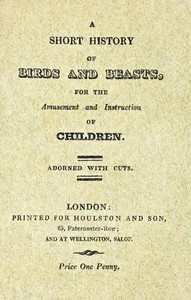
Read on Project GutenbergThis penny chapbook, printed by F. Houlston and Son in Wellington, opens with a frontispiece of a lion and a couplet that immediately establishes its dual purpose: amusement and instruction. The lion is called “the King of all Beasts,” and the child reader is urged to be “the King of Good Boys” by learning diligently. This pattern—an animal introduced with a short verse, then a prose paragraph that draws a moral—repeats across fifteen entries. The author’s voice is direct and often stern, addressing the child as “you” and contrasting Christian virtue with heathen cruelty. The Cock entry, for instance, condemns cock-throwing as a custom “the very heathens would blush at.” The language is plain, the lessons explicit, and the animals serve as mirrors for human behavior.
Rhyme and Reason: The Verse-Prose Structure
Each entry begins with a four-line rhyming stanza, printed in italic or roman type, followed by a prose paragraph that expands on the animal’s traits and the intended moral. The verse often states a simple fact or proverb: “The Cock doth crow to let you know, / If you be wise, what time to rise.” The prose then shifts to a more detailed, sometimes emotional appeal. In the Parrot entry, the verse says the parrot “prates he knows not what,” and the prose likens the bird to “silly boys, who prate without thinking.” This two-part structure allows the author to first capture attention with rhythm and rhyme, then drive home a lesson with direct address. The verses are memorable and could be recited, while the prose supplies the reasoning.
Moralizing Through Animal Behavior
The author selects specific behaviors to highlight virtues or vices. The Cuckow is praised as “good-natured” for traveling yearly to “sing them a song,” then departing—a model of cheerful, unobtrusive friendship. The Cow is called “good-natured” for providing milk, butter, cheese, and even custards and cheesecakes; the child is reminded of indebtedness. The Nightingale’s sweet song makes the author wish “’twas summer all the year.” These descriptions are not natural history but moral exempla. The Cock, by contrast, is treated with “cruelty” by “idle, wicked, barbarous fellows,” and the child is urged to avoid such inhumanity. The animal’s suffering becomes a lesson in Christian compassion.
Direct Address and the Child Reader
The author repeatedly speaks directly to the child, using “you” and “I hope you.” In the Cock entry, the child is called “a christian” and told to shun cruelty. The Parrot entry warns against learning “without looking at their book.” The Cow entry uses “we” to include the reader in collective gratitude. This technique creates a sense of personal accountability. The child is not a passive listener but is implicated in the moral system. The author’s tone is parental—sometimes gentle, sometimes scolding—and assumes the child can reason and improve. The frontispiece explicitly addresses “you, as the King of Good Boys,” linking animal hierarchy to human conduct.
Economy of Description and Didactic Purpose
Descriptions are minimal and functional. The Cow is “red,” the Cuckow is “pretty,” the Nightingale is “pretty” and sings “sweetly.” There is no attempt at scientific accuracy; the goal is moral instruction, not ornithology. The author uses concrete, familiar details: the Cock is tied to a stake, the Cow’s udder is full of milk, the Parrot chatters. Each detail serves the lesson. The brevity of the entries (often under 100 words) and the penny price suggest the book was intended for wide circulation among families or schools. The author assumes a shared cultural knowledge of animals and their conventional traits, reinforcing social and religious norms through simple, repetitive patterns.
This chapbook offers a window into early nineteenth-century children’s literature, where amusement and instruction were tightly interwoven. Readers today may note the author’s reliance on animal stereotypes and the explicit moralizing that leaves little room for ambiguity. The direct address and simple verse-prose structure make it a useful text for studying how didactic literature shaped childhood reading. Approach it as a historical artifact of moral education, not a natural history guide.
Back then, those little animal rhymes felt truer than the schoolroom, each creature a mirror for some quiet fault. I still think of the diligent ants. Years later, reading about the real, shaggy lives of high-country mammals—their patient gnawing, their watchful stillness—made me miss that chapbook's gentle certainty. A kind of hush lingers in both, if you listen. Mammals of the Grand Mesa, Colorado — Reading Notes feels like a grown-up echo of that same old calm.
There are no reviews for this eBook.
There are no comments for this eBook.
Reader reflection
Record your reading impressions
A brief reflection can help important ideas stay with you longer.
Your progress
0
/
10
2
How did the book work for you overall?
3
How likely are you to recommend this book?
4
How easy was the book to follow?
5
Did anything about the book feel genuinely new?
6
Which element worked best for you?
7
Did the book deliver what you hoped for?
8
Do you expect to return to this book?
9
In one sentence, what did you learn?
10