
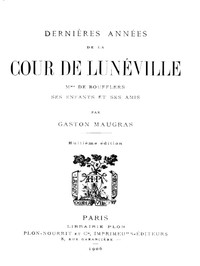
Dernières Années de la Cour de Lunéville by Gaston Maugras
Gaston Maugras’s book is a deep dive into a very specific time and place: the court of Lunéville in Lorraine, France, during the 1760s and 1770s. This was the domain of the exiled Polish king, Stanislas Leszczyński, a man of taste and kindness who created a miniature Versailles in eastern France. But this isn't just a dry history of architecture and treaties. Maugras uses letters, memoirs, and official documents to reconstruct the daily life, dramas, and personalities that filled its halls.
The Story
There isn't a single plot, but rather a collection of interwoven lives. At the center is the aging Duke Stanislas, a figure of fading grandeur trying to maintain a glittering court. Around him orbits his formidable daughter, Marie Leszczyńska, the Queen of France, whose visits are major state events. The book follows the intricate social dances, the artistic pursuits, the petty rivalries, and the romantic entanglements of the courtiers. We see philosophers like Voltaire correspond with the Duke, and watch as young nobles navigate a system built on privilege. The real tension comes from the unspoken question hanging over everything: How long can this fragile, outdated world last? The story quietly builds toward the inevitable—the death of Stanislas in 1766, which leads to the absorption of Lorraine into France and the swift dissolution of his exquisite court.
Why You Should Read It
What makes this book special is its intimacy. Maugras isn't interested in grand battles or political maneuvers (though they're in the background). He's fascinated by people. He shows us the Duke's very human fears about his legacy, the loneliness of the Queen, and the calculated ambitions of lesser nobles. You get a sense of the smells, sounds, and textures of 18th-century life—the rustle of silk, the strain of court etiquette, the gossip whispered in garden groves. It reads less like a textbook and more like you're peering through a keyhole into a lost world. You come away understanding not just what happened, but how it felt to live through the sunset of the aristocratic age.
Final Verdict
This book is perfect for history buffs who are tired of kings and dates and want to understand the human heart of a bygone era. It’s also great for readers who enjoy rich, character-driven narratives, even if they're nonfiction. Be warned: it’s a detailed, slow-burn kind of read, not a fast-paced thriller. But if you let yourself sink into it, 'The Last Years of the Court of Lunéville' offers a uniquely poignant and personal portrait of an ending—the final, brilliant flicker of a candle before it goes out.
This book is widely considered to be in the public domain. Thank you for supporting open literature.
Jessica Jones
1 year agoA bit long but worth it.
Jackson Jackson
1 year agoComprehensive and well-researched.
Ethan Wilson
2 years agoI have to admit, the emotional weight of the story is balanced perfectly. Don't hesitate to start reading.
Barbara Ramirez
2 years agoSimply put, the atmosphere created is totally immersive. Thanks for sharing this review.









Jennifer Robinson
11 months agoWithout a doubt, the character development leaves a lasting impact. Worth every second.