
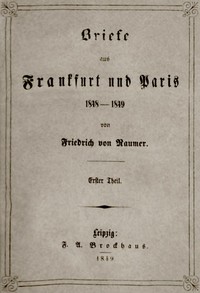
Briefe aus Frankfurt und Paris 1848-1849 (1/2) by Friedrich von Raumer
Friedrich von Raumer's Briefe aus Frankfurt und Paris 1848-1849 isn't a novel with a plot. It's better. It's a front-row seat to history as it happened. Raumer, a respected historian, was living and working in Frankfurt when the 1848 revolutions erupted across Europe. This book is the first half of his personal letters from that turbulent period, first from Frankfurt and later from Paris.
The Story
There's no traditional narrative arc. Instead, we follow Raumer's day-to-day experiences. In Frankfurt, he's in the middle of the German National Assembly's attempt to create a unified, democratic Germany. He describes the debates, the idealism, and the frustrating political gridlock. Then, he travels to Paris just after the bloody June Days uprising of 1848. His letters from Paris are even more intense. He walks a city scarred by recent street fighting, reports on the shaky new government, and listens to the angry murmurs of the working classes. The "story" is the slow, often painful realization that the bright hopes of spring 1848 are hardening into disappointment, violence, and the return of strongman politics.
Why You Should Read It
This book removes the glass from the museum display. History here is loud, messy, and confusing. Raumer doesn't know how it ends. One letter might be hopeful about progress; the next is filled with dread after a violent clash. You feel his intellectual struggle to make sense of the chaos. The real power is in the small details: the cost of bread, the mood in a café, the anxiety of not knowing if the street you need to take is blocked by a barricade. It makes you understand that people living through revolutions aren't thinking about chapters in a future textbook—they're worried about their safety, their neighbors, and whether their world is falling apart.
Final Verdict
This is a perfect read for anyone who finds standard history books too clean and distant. If you loved the immersive feel of Erik Larson's books or the personal diaries from any era, you'll be fascinated by this. It's especially rewarding for readers interested in the messy birth of modern Europe, democratic movements, or just incredible eyewitness accounts. A word of caution: it's a primary source, so it helps to have a basic timeline of 1848 in mind. But even without it, Raumer's voice—curious, concerned, and brilliantly observant—guides you through the storm. It's history with its hair down.
This title is part of the public domain archive. Share knowledge freely with the world.
Robert Jackson
9 months agoVery interesting perspective.
Betty Harris
9 months agoIf you enjoy this genre, the arguments are well-supported by credible references. A true masterpiece.
Sandra Nguyen
1 year agoThis is one of those stories where it challenges the reader's perspective in an intellectual way. Absolutely essential reading.
Deborah Wright
1 year agoFinally found time to read this!






Barbara Ramirez
1 year agoThis is one of those stories where the flow of the text seems very fluid. Truly inspiring.